Home › Sarasota Water Hardness
Guide · Sarasota water quality
Sarasota Water Hardness and Your Water Heater
Most hard-water pages guess at their numbers. This one doesn't have to: Sarasota County publishes its own water quality report, and the figures in it explain a good share of the water heater trouble we get called to — the rumbling tanks, the elements that burn out young, the tankless units flashing scale warnings.
Short answer: Sarasota County's 2024 water quality report says the county's raw groundwater starts at about 1,120 mg/L of hardness and is softened to roughly 120–125 mg/L before delivery — about 7 grains per gallon, right on the US Geological Survey's line between “moderately hard” and “hard.” Not extreme water, but more than enough to fill a tank with sediment and coat a tankless heat exchanger over the years. What it does to each type of heater, and what actually helps, is below.
The county's own numbers
Sarasota sits on limestone, and limestone is why Florida groundwater is loaded with calcium and magnesium. Sarasota County's 2024 Consumer Confidence Report — the annual water quality report the county is required to publish — gives the two numbers that frame everything on this page: the raw groundwater starts at about 1,120 mg/L of hardness, and the county's treatment plants soften it to roughly 120–125 mg/L by the time it is delivered to homes.
Two units, one fact. Hardness is quoted in milligrams per litre (the same as parts per million), and softener settings use grains per gallon — divide by 17.1, so 120–125 mg/L is about 7 grains per gallon. The US Geological Survey sorts water into bands: soft up to 60 mg/L, moderately hard 61–120, hard 121–180, very hard above 180. Sarasota's delivered range straddles the boundary — the top of moderately hard, tipping into hard. Keep that in proportion: the county has already removed around ninety per cent of the hardness before delivery. What remains is not a crisis; it is a maintenance schedule. One exception worth knowing: homes on private wells skip the county's softening entirely, and untreated well water in limestone country can look much closer to that raw four-figure number — if that's you, test before you assume anything on this page applies at the same pace.
This guide explains the water; the fixes live on their own pages. Flushing and anode care are on the maintenance page, element failures on the electric repair page, and water heater pros in Sarasota is where the services start. One explanation, in one place, that every other page can point to — that is deliberate.
Inside a standard tank: sediment is the story
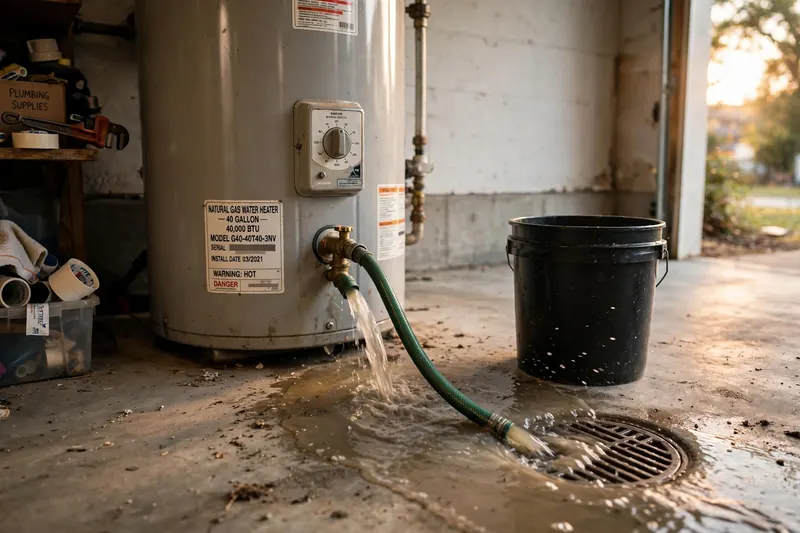
Hardness minerals behave worst at temperature. Heat the water and calcium carbonate comes out of solution and settles — as sediment, on the floor of the tank, exactly where a standard electric tank does its work. Three consequences follow, in the order homeowners usually meet them.
- The rumbling. Water trapped under the sediment layer superheats and flashes to steam, popping up through the layer. That kettle noise is the classic Sarasota soundtrack of a tank that hasn't been flushed, and it is the sediment announcing itself, not the tank dying.
- The buried element. Sediment climbs until it blankets the lower heating element, which then overheats inside its own insulation and burns out — the failure pattern our electric repair page is built around. Lukewarm water that fades after one shower is the usual first symptom.
- The quiet tax. A sediment layer forces longer, harder heating cycles to deliver the same hot water. No honest page can put a single percentage on that for your tank — depth, age and usage all move it — but the direction is never in doubt.
Working alongside the sediment story is the anode rod, the sacrificial rod that corrodes so the tank doesn't. In mineral-active water it is consumed steadily doing that job; once it is spent, the tank's own steel takes over as the sacrifice. Checking it is routine maintenance, and it is the cheapest tank-life insurance there is.
Tankless: where the same water bites harder
A tankless unit has no floor for sediment to settle on — instead, the same minerals plate directly onto the heat exchanger's narrow water passages as scale. Scale is insulation in the worst place: the exchanger must be driven harder to push heat through it, temperatures swing, and eventually the unit protects itself and shuts down. The manufacturers know this failure so well they built warnings for it — Rinnai's LC code means, literally, scale buildup in the heat exchanger, and it is decoded on our Rinnai page.
The defence is descaling — circulating a cleaning solution through the exchanger to dissolve the scale before it hardens into a fault. At Sarasota's hardness the working rhythm is annual, and the full picture of tankless upkeep is on the tankless page. A hybrid heat pump heater, for completeness, carries a tank and behaves like one for these purposes — sediment and flushing — with its own extra item, a washable air filter, covered on the heat pump page.
The signs your heater is losing to scale
- Rumbling, popping or kettling from a tank that used to run quietly.
- Hot water fading faster than it did a year or two ago — recovery shrinking as sediment and element damage accumulate.
- One good shower, then lukewarm — the buried or burned-out lower element's signature.
- A tankless unit showing codes — Rinnai's LC above all — or cycling off mid-shower.
- The household tells: white crust building on showerheads and tap aerators, a kettle that furs up, glassware spotting. What you can see on the fixtures is the same process you can't see inside the heater.
And one impostor to rule out: a rotten-egg smell in the hot water is not hardness. It is sulphur bacteria reacting with a magnesium anode rod — the fix is a flush and an aluminium/zinc anode, and the FAQ below covers it because the two get blamed on each other constantly.
Do you need a softener? The honest answer
At 120–125 mg/L: not compulsory — provided the heater is actually maintained. A tank that gets its annual flush and an anode that gets checked will live a normal life on Sarasota's delivered water. A softener changes the arithmetic rather than the verdict: set around 7–8 grains per gallon, it stops new scale forming, stretches every maintenance interval, and makes a tankless unit's annual descale a precaution instead of a necessity. What it costs you is the unit itself, salt, and one more appliance to look after.
Three qualifications that softeners are often sold without. A softener does not remove sediment already sitting in an existing tank — flush first, soften second. A softener set below the delivered hardness is a decoration; the setting has to cover roughly 7 grains. And the case for one strengthens a lot if the fixtures tell the same story as the heater — a house replacing showerheads and aerators to scale is paying for hardness twice. Whether it pays for you depends on your heater type and your tolerance for maintenance, which is a plainer way of deciding than any sales pitch.
What to do, by heater type
- Standard tank (electric or gas): flush annually; have the anode checked when the unit is serviced; treat new rumbling as a flush reminder, not background noise. The how and the full routine: maintenance page.
- Tankless: descale annually at this hardness, sooner if codes appear; keep the inlet filter clean. Details: tankless page.
- Heat pump (hybrid): the tank routine above, plus washing the air filter — a clogged filter trips its compressor protections. Details: heat pump page.
- Softener homes: confirm the setting covers ~7 grains per gallon and that regeneration is actually happening — a softener that has quietly stopped is worse than none, because the maintenance got skipped on its promise.
- Private wells: test the water first. Your number decides the schedule, and it may be several times the county's delivered figure.
When scale has already won
Sometimes the maintenance ship has sailed: an element burned out under deep sediment, a heat exchanger scaled past what a descale can recover, a tank whose anode was spent years ago and whose steel has been quietly thinning since. Those are judgement calls, not automatic replacements — an element on a sound tank is a repair worth doing, and our replacement guide works through where the line sits. What the repairs themselves run is published, attributed, on the repair costs page. Either way, the diagnosis comes first and the quote before the work — that order doesn't change because the culprit was the water.
Talk it through first
Not sure this is your problem? Describe the symptom on a two-minute call — we'll point you to the right page or the right fix.
Call (941) 307-1429Questions, answered
Hardness questions
Sarasota County's 2024 water quality report puts delivered water at roughly 120–125 mg/L of hardness — about 7 grains per gallon. On the US Geological Survey's scale, 61–120 mg/L is 'moderately hard' and 121–180 is 'hard', so Sarasota sits right on the line between the two. The county's raw groundwater starts near 1,120 mg/L; its treatment plants do the heavy softening before the water ever reaches your heater.
Yes — slowly, and that's the honest shape of it. Hardness doesn't break a heater in a season; it builds sediment in tanks and scale in tankless heat exchangers year after year, and the failures that follow (burned-out elements, rumbling tanks, scale shutdowns) are the ones we repair most. The county's softening keeps it manageable — manageable, with maintenance, is the operative phrase.
Annually, at this hardness — a tank flush to clear sediment, and a descale on the same rhythm for a tankless unit. The step-by-step and what a proper flush includes are on our maintenance page; the short version is that a flush is cheap and the element or exchanger it protects is not.
Sediment, almost always. A layer of mineral sediment on the tank floor traps water beneath it; that water flashes to steam and pops through the layer — kettling, in the trade. A flush usually settles it. If the rumbling returns quickly, the sediment is deep or the lower element is buried in it, and that's a service visit rather than another hose-down.
It stops new scale forming, which is most of the battle — set it around 7–8 grains per gallon to cover Sarasota's delivered hardness. What it won't do is remove sediment already sitting in the tank, so the right sequence is flush first, softener second. After that, heater maintenance stretches out: flushes still happen, but they come back nearly clean, and a tankless unit's annual descale becomes a precaution instead of a rescue.
That's not the hardness — it's a different chemistry with a similar address. Sulphur bacteria in the tank react with a standard magnesium anode rod and produce the smell. The established fix is flushing the tank and swapping to an aluminium/zinc anode. It belongs on this page because homeowners understandably blame the water's minerals for it, and the minerals are innocent this once.
Water on the floor? No hot water at all?
Talk to a water heater pro now
One call describes the problem, confirms your area, and gets a local water heater pro on the job.
(941) 307-1429