Home › Heat Pump Water Heaters
Heat pump (hybrid) · Sarasota, FL
Heat Pump Water Heaters in Sarasota, FL
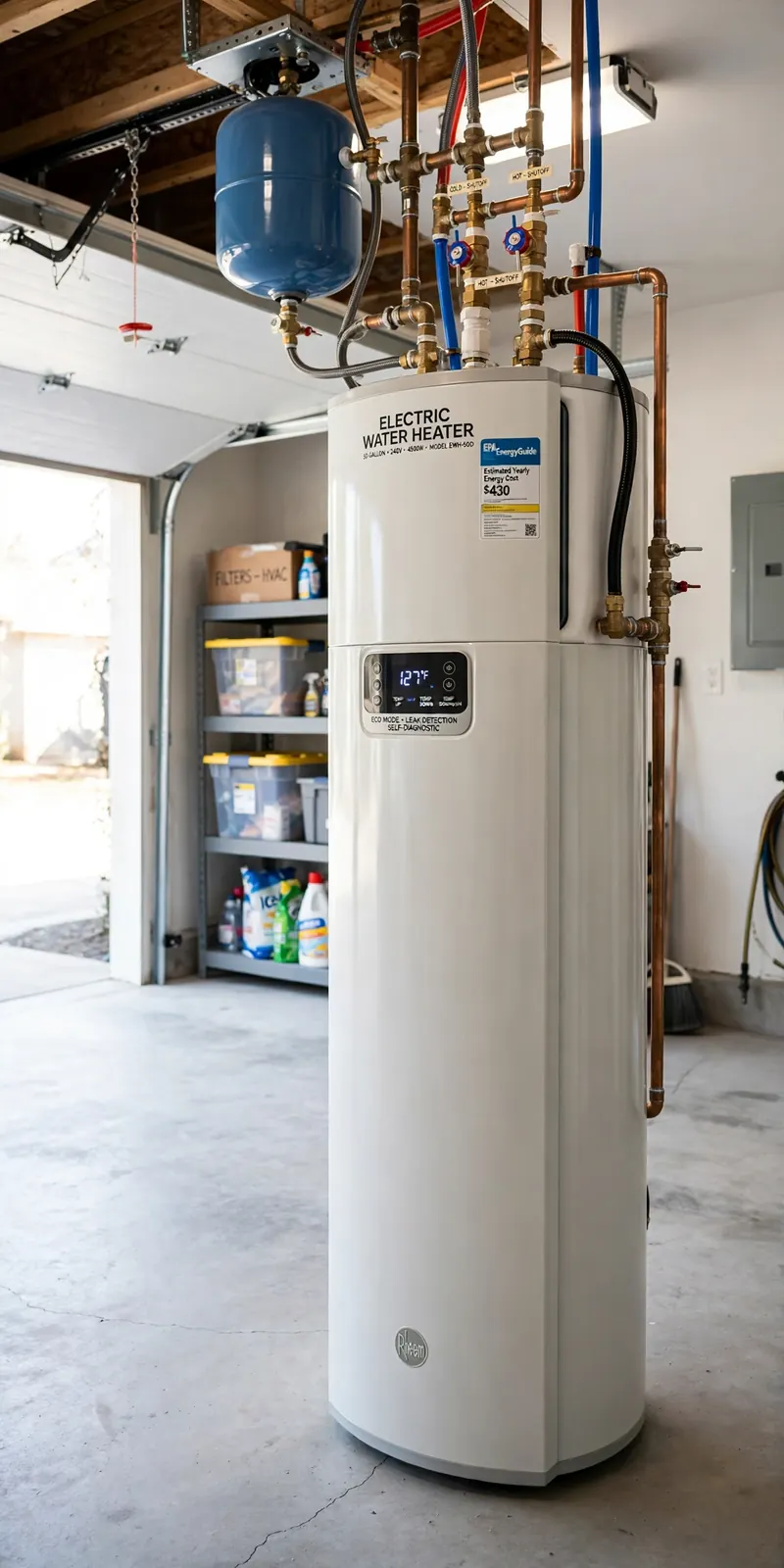
A heat pump water heater is the most efficient way to heat water in a Sarasota home — and a Sarasota garage is close to its ideal home. We repair the hybrids already running here, and we install new ones where they genuinely fit.
Short answer: a hybrid pulls heat out of the air around it instead of making heat with elements, using roughly a third of the electricity of a standard electric tank (ENERGY STAR). Sarasota's climate suits it almost all year. The honest complications: installed cost runs higher — Angi's current guide puts professional installation at $3,200–$4,700 — and the federal tax credit still advertised all over the web ended on 31 December 2025. Fit, costs and what breaks, with sources, below.
How a hybrid actually heats water
A heat pump water heater — most people call it a hybrid — is a tank with a small refrigeration circuit on top. A compressor and fan pull heat out of the surrounding air and move it into the water, the reverse of how a refrigerator works. Standard electric elements stay in the tank as backup and boost, which is where the name comes from.
The efficiency gap is not marginal. Current hybrids carry efficiency ratings (UEF) of about 3.75–4.00 for Rheem's ProTerra line and 3.80–4.02 for A.O. Smith's Voltex line; a standard electric tank sits around 0.93. In plain terms, the hybrid delivers three to four units of hot water for every unit of electricity a conventional tank uses one for — ENERGY STAR summarises it as roughly a third of the electricity. Every hybrid also offers modes: heat-pump-only for maximum savings, a hybrid mode that adds the elements when demand spikes, an electric-only mode, and a vacation setting.
If you are weighing a hybrid against simply replacing the standard tank, our replacement guide works through the repair-or-replace maths, and water heater pros in Sarasota is where every service starts. This page is the heat pump specifics only — that separation is deliberate, so each page answers one question properly.
Why Sarasota is heat-pump country
Heat pumps have one well-known weakness — cold air — and Sarasota barely has any. Manufacturers rate these units to run in heat-pump mode from roughly 37°F; NOAA's climate normals put Sarasota's average January low at about 52°F, and a garage sits warmer than the outdoors. The cold-climate objection that follows hybrids around up north simply doesn't apply here.
Better still, the side effect runs in your favour. While it heats water, a hybrid returns roughly 2,500–5,000 BTU/hour of cooling and dehumidification to the space around it (ENERGY STAR) — in a Sarasota garage or laundry room, that is free comfort for most of the year, not a penalty. Garage placement also answers the two practical questions at once: a garage typically offers the air volume the unit wants, and the 45–49 decibels of fan and compressor noise (manufacturer specs) stays out of the living space.
What a Sarasota installation has to get right
- Air. Rheem's manual asks for a room over about 700 cubic feet, or louvres/a louvred door, or a ducting kit in smaller spaces — starved of air, a hybrid loses the efficiency you paid for.
- Condensate. Pulling heat from humid Florida air makes water, steadily. The unit needs a drain or a condensate pump, and the line needs to be routed so it can't quietly clog — an algae-blocked condensate line is a Florida-specific failure we see on anything that drains.
- Power. A typical hybrid runs on a 240V/30A circuit, like a standard electric tank — but the existing run gets checked, not assumed.
- Size. Hybrids are taller than the tank they replace. The space, the doorway and the drain pan get measured before a model is recommended, not after it arrives.
- Permit and elevation. A replacement needs a permit in Sarasota County and in the City of Sarasota — our permit guide has the rules. In flood hazard areas, the Florida Building Code (Plumbing §309.2) also puts water heaters on the flood-elevation list at installation, which can change where and how the new unit sits.
What it costs — with the receipts
Published figures, attributed — because the site doesn't publish a price list of its own and every job here is quoted after diagnosis. Angi's heat pump water heater installation guide (updated October 2026) gives a normal range of $3,200–$4,700 for professional installation, averaging $4,200. The heaters themselves, checked November 2026: a 50-gallon A.O. Smith Voltex at $1,950 (Lowe's) and a 50-gallon Bradford White AeroTherm at about $2,474 (SupplyHouse). A hybrid install costs more than a like-for-like tank swap because of the condensate work, the electrical check and the unit itself.
The running-cost side, shown with its inputs so you can test it: at an electricity price of about 13.5¢/kWh (a fair all-in FPL band; your marginal rate may differ) and a typical household draw, a standard electric tank works out near $475 a year to run, a hybrid near $130 a year — a modelled saving around $345 a year. ENERGY STAR's national figure for a family of four is about $550 a year; that's a national average at higher rates, quoted here as exactly that. Bigger households save more, smaller ones less — anyone who promises you a precise saving without asking about your usage is guessing.
The incentive picture, told straight
Two things you'll read elsewhere that are no longer true, and one thing that's coming. The federal tax credit is over. The Energy Efficient Home Improvement Credit — the 30%-up-to-$2,000 credit for heat pump water heaters — ended for equipment placed in service after 31 December 2025, per the IRS. A unit installed in 2025 can still be claimed on a 2025 return; a 2026 installation cannot. Pages and quotes still advertising it in 2026 are working from stale copy. There is no FPL water heater rebate — FPL's current offers include a $200 rebate, but it's for air conditioning, and Florida's state energy rebate programmes are not open for applications.
What's coming is the DOE's 2024 rule: from 6 May 2029, newly manufactured electric storage water heaters over 35 gallons must meet efficiency levels that in practice only heat pump technology reaches. Nothing about it forces an early replacement — it simply means that when today's standard tanks eventually wear out, their replacements will increasingly be hybrids. Buying one now, on your own schedule, beats meeting one for the first time during a no-hot-water emergency.
What breaks on a hybrid — and what it means
Hybrid faults split cleanly in two, and knowing which side yours is on decides repair versus replacement before anyone sells you anything.
- Repairable: heating elements, temperature sensors, the fan, the control board, a blocked condensate line — and the humble air filter. The filter is a washable screen on top of the unit, and manufacturers build neglect into their diagnostics: Rheem's airflow shutdown code (A005) starts its checklist with "check air filter and clean if necessary," and A.O. Smith dedicates a fault code to a dirty filter outright. It is the one maintenance job a hybrid adds over a standard tank, and skipping it trips compressor-protection shutdowns.
- Effectively terminal: the sealed refrigeration circuit. Rheem states it plainly in its own manual — "we do not service sealed system parts." A failed compressor or a refrigerant leak on a unit outside warranty is therefore a replacement conversation, whatever the tank's age. Any provider who quotes you a cheap compressor swap on a hybrid is quoting work the manufacturer doesn't support.
The working rule: controls, fan, elements and drainage on a sound tank are repairs. A sealed-system fault is a replacement decision — and that's when the repair-or-replace comparison, both prices side by side, matters most.
Heat pump, standard electric, or tankless?
Three honest profiles. Heat pump: highest upfront cost of the tank options ($3,200–$4,700 installed, Angi), lowest running cost by a wide margin, needs air volume and a condensate drain; the default choice for a Sarasota garage and a high-use household. Standard electric: cheapest to install, roughly $475 a year to run on the model above, fits closets and lowboy spaces a hybrid can't — still the right answer for a small household, a tight condo closet, or a short remaining time in the home; repairs live on our electric repair page. Tankless: no storage and no standby loss, the highest installation complexity, and in Sarasota's mostly-electric housing stock its per-gallon cost lands near resistance electric unless gas is available — the full picture is on the tankless page. The right answer is the one that fits your space, your draw and your years in the house — in that order.
Talk it through first
Not sure this is your problem? Describe the symptom on a two-minute call — we'll point you to the right page or the right fix.
Call (941) 307-1429Questions, answered
Heat pump questions
Yes — a garage is close to its ideal home here. Hybrids draw heat from the air around them and run in heat-pump mode from roughly 37°F up (manufacturer specs); Sarasota's average January low is about 52°F outdoors, and garage air runs warmer than that. The two real requirements are air and drainage: a room over about 700 cubic feet, or louvres/ducting if the space is smaller, and a condensate drain. Both are checked before we quote.
More than a standard tank, and any page that hides that isn't helping you. Angi's current installation guide (updated October 2026) puts professional installation in a normal range of $3,200–$4,700, averaging $4,200. The units themselves: a 50-gallon A.O. Smith Voltex was $1,950 at Lowe's and a 50-gallon Bradford White AeroTherm was about $2,474 at SupplyHouse, checked November 2026. Your quote follows a site check, because condensate routing and the electrical run are what move the number.
No — and this is where a lot of 2026 web pages are simply out of date. The federal Energy Efficient Home Improvement Credit ended for equipment placed in service after 31 December 2025 (IRS); a unit installed during 2025 can still be claimed on a 2025 tax return, but a 2026 installation gets nothing. FPL offers no water heater rebate — the $200 FPL rebate you'll see mentioned is for air conditioning. If a quote you're holding leans on a 30% credit, it's leaning on a stale page.
Nobody is forcing your existing heater out. The DOE's 2024 efficiency rule binds water heaters manufactured or imported from 6 May 2029: new electric storage tanks over 35 gallons will have to meet efficiency levels that, in practice, only heat pump technology reaches. Heaters already installed, and stock made before the deadline, are unaffected. It simply means the heat pump becomes the standard electric tank over time — one more reason to understand it now rather than during an emergency swap.
Manufacturer specs put current models at about 45–49 decibels — roughly a modern dishwasher — from the compressor and fan. That's exactly why Sarasota's usual placement suits them: in a garage or a laundry room with the door shut, most households never hear them. A unit going into a living-space closet deserves a noise conversation before it deserves a signature.
Yes, if it's sized for the household rather than copied from the old tank. Heat-pump mode recovers more slowly than elements alone, so hybrids carry a hybrid mode that brings the elements in during demand peaks, and sizing up — a 65- or 80-gallon hybrid where a 50-gallon standard tank sat — is common practice for families. First-hour delivery is the number that matters, and we size from your actual draw: showers, laundry, guests, the lot.
Water on the floor? No hot water at all?
Talk to a water heater pro now
One call describes the problem, confirms your area, and gets a local water heater pro on the job.
(941) 307-1429